Knowing Moroccan Arabic (Darija) is key for talking well in Morocco. It’s useful for traveling, business, or cultural exchange. Learning key phrases and translation tips can make your experience better.
Translating Moroccan to English can be tough. But, with the right help, you can get past these challenges. For example, phrases like “I love you” (Kanbghik – كنبغيك), “I miss you” (Twe77eshtek – توحشتك), and “Welcome” (Mer7ba – مرحبا) are easy to learn. You can find them in 50 basic words and phrases in Moroccan. This makes talking easier.
Key Takeaways
- Understanding Moroccan Arabic enhances cultural exchange and communication.
- Learning essential phrases facilitates travel and business interactions.
- Translation tips can help overcome language barriers.
- Basic phrases like greetings and expressions of affection are easily learned.
- Resources like language guides can significantly aid in translation.
Understanding Moroccan Arabic (Darija)
Darija is the everyday Arabic spoken in Morocco. It’s different from Standard Arabic and shows Morocco’s rich culture. Knowing Darija is key for clear communication, whether you use a Moroccan dictionary or online translation services.
How Darija Differs from Standard Arabic
Darija and Standard Arabic differ mainly in words and how they’re spoken. Standard Arabic is for formal talks and writing. But Darija is what Moroccans talk about every day. This difference comes from Morocco’s history and cultural mix.
The Influence of Berber, French, and Spanish
Darija’s mix of languages shows Morocco’s diverse culture. Berber, the native language, has greatly influenced Darija. French and Spanish words also show up because of Morocco’s past colonizers.
Regional Variations Within Morocco
Darija changes a lot from one part of Morocco to another. These changes come from local cultures, history, and geography. For example, Marrakech and Fez have their own Darija, different from rural areas. This shows Morocco’s varied language scene.
The Basics of Moroccan to English Translation
When you start translating Moroccan Arabic to English, it’s important to know the differences. These include the structure of the language, how words are pronounced, and the writing systems. Understanding these basics is key to doing a good job.
Linguistic Structure Differences
Moroccan Arabic, or Darija, has a unique way of arranging words in sentences. It follows a verb-subject-object order, unlike English’s subject-verb-object order. This difference can make translations tricky if not handled right.
Darija also has many loanwords from French and Spanish. This is because of Morocco’s history with these cultures. An english to moroccan translator needs to know these loanwords and their English equivalents for accurate translations.

Pronunciation Challenges
Pronunciation is a big challenge in translating Moroccan Arabic to English. Darija has sounds not found in English, making it hard for non-native speakers to get right. For example, the “kh” sound in Darija is tricky for English speakers to pronounce.
A best moroccan translator must be good in both languages. They also need to get the pronunciation right to make sure the translation is clear and correct.
| Aspect | Moroccan Arabic (Darija) | English |
|---|---|---|
| Word Order | Verb-Subject-Object | Subject-Verb-Object |
| Loanwords | Incorporates French and Spanish words | Primarily uses Latin-derived and Germanic words |
| Pronunciation | Includes unique sounds like “kh” | Does not have “kh” sound |
Writing Systems and Transliteration
Darija is not written in a standard way, making transliteration hard. Arabic script is used for formal writing, but Darija in Latin script can vary a lot. A reliable english to moroccan translator needs to handle these variations well for consistent translations.
Translating Darija into English requires careful thought. This ensures the translated text is clear and accurate.
Essential Greetings and Polite Expressions
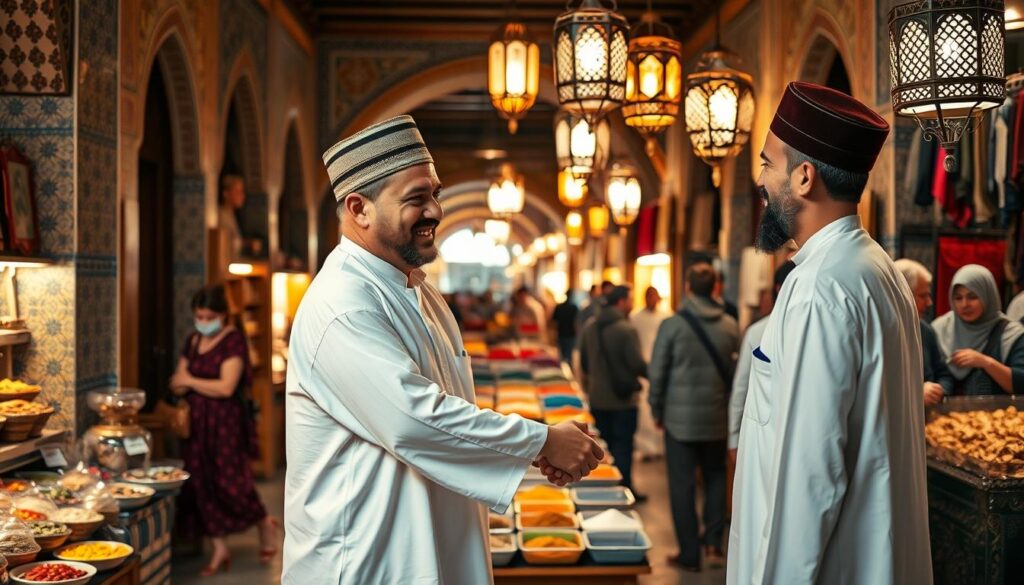
To get around in Morocco, knowing key greetings and polite words is key. Moroccan Arabic is full of greetings that show the culture’s love for hospitality and respect.
Formal and Informal Greetings
In Morocco, greetings can be formal or casual, based on who you’re talking to and where you are. Knowing the difference helps make a good first impression.
Morning, Afternoon, and Evening Greetings
Moroccan Arabic changes its greetings with the time of day. For example, “As-salamu alaykum” (السلام عليكم) means “Peace be upon you” and is used all day. For a specific time, you might say “Sabah al-khayr” (صباح الخير) for “Good morning,” or “Masaa al-khayr” (مساء الخير) for “Good evening.”
Religious Greetings
Morocco’s strong Islamic roots make religious greetings common. Saying “As-salamu alaykum” is not just a greeting but also a wish for peace. The reply, “Wa alaykum as-salam” (وعليكم السلام), means “And upon you be peace.”
Expressions of Gratitude and Respect
Showing thanks and respect is big in Moroccan culture. Saying “Shukraan” (شكرا) means “Thank you.” For more formal or deep thanks, say “Shukraan jazilan” (شكرا جزيلا), which means “Thank you very much.” To show respect, use titles like “Mr.” or “Mrs.” followed by the surname, just like in Western cultures.
For more phrases and to practice your pronunciation, check out Arabic Spoken. It’s a great resource for learning Arabic conversation phrases.
Farewell Phrases
Moroccans have different ways to say goodbye. A common one is “Ma’a as-salaama” (مع السلامة), which means “With safety” or “Goodbye.” Another is “Ila al-liqaa'” (إلى اللقاء), which means “Until the meeting again” or “See you later.”
Here’s a summary table of essential greetings and expressions:
| Greeting/Expression | Moroccan Arabic | English Translation |
|---|---|---|
| As-salamu alaykum | السلام عليكم | Peace be upon you |
| Sabah al-khayr | صباح الخير | Good morning |
| Masaa al-khayr | مساء الخير | Good evening |
| Shukraan | شكرا | Thank you |
| Ma’a as-salaama | مع السلامة | Goodbye |
Practical Travel Phrases for Visitors to Morocco
Traveling in Morocco is easier with the right phrases. Knowing local words helps a lot. It’s useful for asking directions, booking hotels, or in emergencies.
Transportation and Directions
Understanding transportation vocabulary is key. Knowing how to ask for directions and understanding answers is very helpful.
Taxi and Public Transport Vocabulary
For taxis and public transport, you need to know “taxi” (taxi in Darija), “bus” (otobis), and “train” (qitar). To hail a taxi, say “wahd taxi please” (a taxi, please).
Asking for Directions
To ask for directions, use “Fein howa…” (Where is…). For example, “Fein howa Medina?” means “Where is the Medina?” It’s important to understand the answers, like “straight” (straight ahead) or “turn left/right” (dor liseral/lidrouat).
Accommodation Vocabulary
For accommodation, knowing a few phrases helps. You might ask for “a room with a view” (chambre b vue) or the “price per night” (lkhadem b lil).
Emergency Phrases
In emergencies, clear communication is key. Phrases like “Help!” (Enqezni!) or “I need a doctor” (Need a doctor or Kan7taj dakter) are lifesavers. Knowing “Where is the nearest hospital?” (Fein howa l’ispital l’qrib?) is also useful.
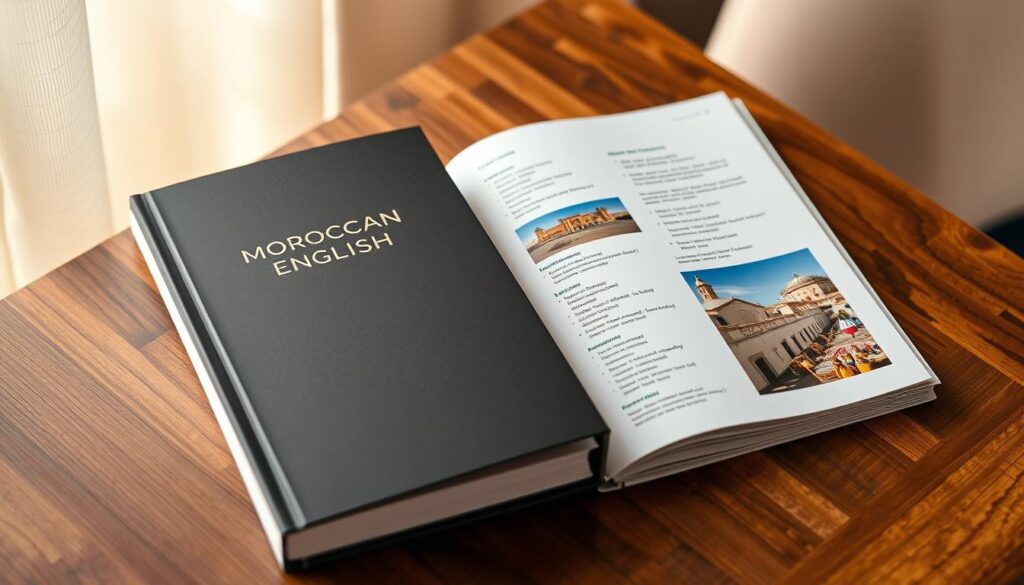
Learning these phrases makes your trip to Morocco better. You’ll handle situations more easily, making your visit enjoyable and stress-free.
Food and Dining Vocabulary
When you travel to Morocco, knowing food and dining words is key. It helps you order, ask for tips, and share your food likes. These phrases make eating out in Morocco better.
Ordering in Restaurants
To order well in Moroccan restaurants, learn some phrases. Say “ana baghi” (I want) and then the dish name. For example, “ana baghi tagine” means “I want tagine.”
Ask for the best dish by saying “ash kayn al-ahsan?” (what is the best?).
To get the menu, say “al-ka’ba, min fadlik” (the menu, please). When you’re ready, say “na’mal al-tasjil, min fadlik” (I’ll have…, please).
Traditional Moroccan Dishes and Their Names
Moroccan food is rich and varied, with famous dishes. Learn names like “tagine,” “couscous,” and “harira.” These are common in Moroccan meals.
Try different local foods by asking for “al-akl al-mahalli” (local food).
Dietary Restrictions and Preferences
If you have special dietary needs, knowing how to say it is helpful. Vegetarians can say “ana nabati” (I am vegetarian). For gluten-free, say “ana urid ghida’ bila gluten” (I want gluten-free food).
For other needs, a phrase card or app can help a lot.
| Dish/Request | Moroccan Arabic Phrase | English Translation |
|---|---|---|
| Requesting the Menu | al-ka’ba, min fadlik | The menu, please |
| Ordering Tagine | ana baghi tagine | I want tagine |
| Vegetarian Option | ana nabati | I am vegetarian |
Learning these food and dining phrases makes your trip to Morocco better. Whether in souks or cozy riads, you’ll enjoy your food more.
Shopping and Bargaining Phrases
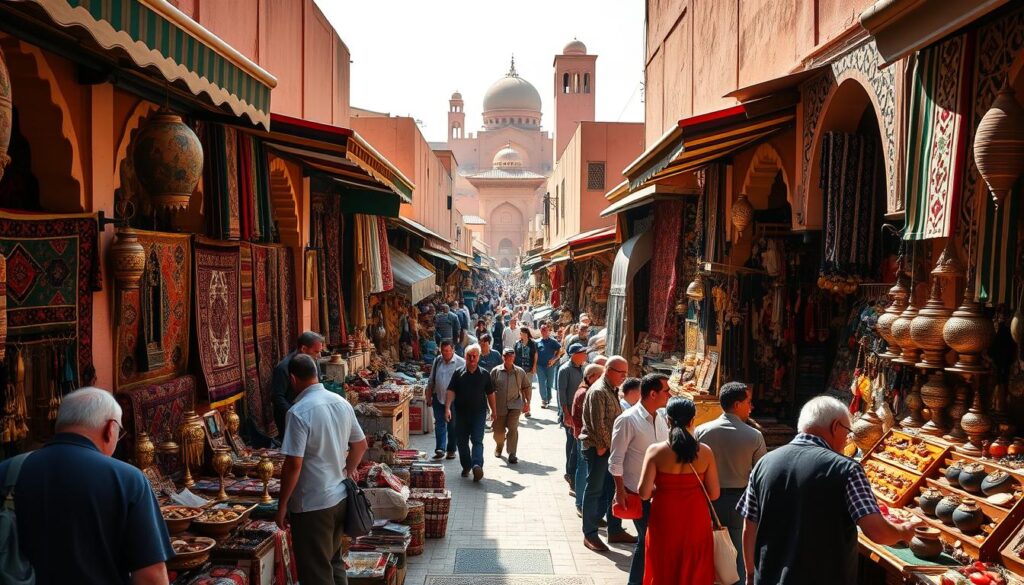
Effective bargaining in Moroccan souks starts with understanding key phrases and expressions. When you visit the vibrant markets of Morocco, knowing how to negotiate like a local can make your shopping better. You might also want to get help from a best Moroccan translator to grasp the language’s subtleties.
Negotiating in Moroccan Souks
Negotiating in Moroccan souks is more than just numbers; it’s about culture and respect. Start by greeting the vendor warmly and showing real interest in their goods. Say “As-salamu alaykum” (Peace be upon you) to start. Remember, haggling is a big part of the shopping experience here.
Numbers and Currency Terms
Knowing numbers and currency terms is key when shopping in Morocco. Learn the Darija numbers: “wahad” (one), “juj” (two), “tlata” (three), and so on. Knowing the Moroccan dirham (MAD) and asking “How much is this?” (“Bshhal hadchi?”) helps with transactions.
Quality and Price Inquiries
To ask about quality and price, say “What’s the price of this?” (“Shحال hada?”) or “Is this the best price you can offer?” (“Hadak huwa ahssn thaman?”). A professional Moroccan translator can help you understand these interactions and ensure you get a good deal.
| Phrase | Translation | Usage |
|---|---|---|
| As-salamu alaykum | Peace be upon you | Greeting vendors |
| Bshhal hadchi? | How much is this? | Inquiring about prices |
| Hadak huwa ahssn thaman? | Is this the best price? | Negotiating prices |
Business and Professional Communication
Understanding professional communication is crucial in Morocco’s business world. Knowing how to greet formally, use meeting terms, and write professional emails is key. These skills will improve your interactions with Moroccan business partners.
Formal Business Greetings
In Morocco, formal greetings are important. Always use titles like “Mr.” or “Ms.” followed by their surname. Saying “As-salamu alaykum” (peace be upon you) shows respect for their culture.
When meeting someone for the first time, ask about their health and family. This shows you care about their well-being.
Meeting and Negotiation Terminology
Good communication is vital in business meetings and negotiations. Learn key terms like “muwafaqa” (agreement), “mufawadha” (negotiation), and “shurut” (conditions). Knowing these can help you discuss better and avoid mistakes.
Having a Moroccan translation service or an English to Moroccan translator can also help. They make communication smoother.
Professional Correspondence
Professional emails or letters need a formal tone. Start with formal greetings and keep your language polished. Be clear and direct to avoid confusion.
Using professional translation services ensures your message is clear and respectful. This helps build strong relationships with Moroccan business partners.
Mastering these communication skills can lead to successful business collaborations with your Moroccan counterparts.
Family and Relationship Terms
Moroccan Arabic has a rich vocabulary for describing family relationships and social interactions. Understanding these terms can help you navigate personal and professional relationships more effectively.
Addressing Family Members
In Moroccan culture, family is highly valued, and the language reflects this importance. Terms like “waldi” (my father) and “ummi” (my mother) are not only used to address one’s parents but also as terms of respect for elders. You can use “akhi” (my brother) and “ukhti” (my sister) to address younger individuals with respect.
Social Relationships and Titles
Moroccans often use titles and honorifics when addressing others, especially in formal or professional settings. For example, “Monsieur” or “Sidi” (sir) and “Madame” or “Lalla” (madam) are used to show respect. In professional contexts, using these titles followed by the person’s name or profession can be very polite.
Terms of Endearment
Terms of endearment are common in Moroccan Arabic, reflecting the culture’s affectionate nature. Phrases like “habibi” (my love) for males and “habibti” for females are used frequently among loved ones. These expressions convey closeness and warmth, similar to how they are used in other Arabic-speaking countries.
Moroccan Idioms and Their English Equivalents
Moroccan Arabic idioms give us a peek into the culture. But, translating them needs a deep grasp of both languages. Idioms add flavor and complexity to our words, making them key for clear communication.
Translating Moroccan idioms into English is more than just swapping words. It’s about capturing the cultural context and meaning. For example, “kalimat haqq” (كلمة حق) means “a word of truth.” It’s used to speak truth to power or say something brave. Knowing this is crucial for accurate online Moroccan translation.
Common Expressions and Their Meanings
Moroccan Arabic is full of expressions that don’t translate directly to English. “Ya khouya” (يا خويا) means “oh my brother.” It’s like saying “buddy” or “mate” in English. These words are important in daily talks and change the conversation’s tone.
Let’s look at a few more examples:
| Moroccan Arabic | Literal Translation | English Equivalent |
|---|---|---|
| Ya zhar | Oh flower | A term of endearment, similar to “sweetheart” |
| Mabrouk | Blessed | Congratulations |
| Inshallah | God willing | Hopefully, or an expression of hope for the future |
Proverbs and Sayings
Moroccan culture is rich in proverbs and sayings. They share wisdom, advice, or thoughts on life. For example, “al-walad yijri b wlidou” means “the child runs with his child.” It shows how problems or responsibilities often follow us. Translating these proverbs needs both language and cultural knowledge, making a best Moroccan translator very important.
For more on translating cultural expressions, check out this academic resource on translation studies.
Humor and Jokes in Translation
Humor is hard to translate because it often relies on cultural references or wordplay. Moroccan humor, with its mix of Arabic, Berber, and French, is especially challenging. A skilled translator must make the humor clear and funny to English speakers.
For example, a joke that uses wordplay in Moroccan Arabic might not translate directly. The translator must keep the humor while making it understandable in English. This task needs both language skills and cultural understanding.
Digital Tools for Moroccan to English Translation
The world of Moroccan to English translation has changed a lot. Now, you can find many digital tools to help you. These tools make it easier to translate Moroccan Arabic (Darija) to English.
Online Dictionaries and Translation Apps
Online dictionaries and apps are easy to use for translating from Moroccan to English. You can find both free and paid services.
Free Resources
There are many free online platforms for translation. They can translate words, phrases, and sentences. Some popular ones are:
- Google Translate: It’s not perfect but a good start for basic texts.
- Darija Dictionary: A great tool for Moroccan Arabic.
Premium Services
If you need more accurate translations, there are premium services. They offer professional translators and better algorithms.
- Darija AI Platform: Uses AI for advanced Moroccan Arabic translations.
- Specialized translation apps: Some apps have premium features for a fee.
Language Learning Platforms for Moroccan Arabic
Language learning platforms are also useful for learning Moroccan Arabic. They have interactive lessons and quizzes.
- Duolingo: It’s great for learning many languages, even if it doesn’t have Darija yet.
- Mondly: Offers courses in many languages with cultural insights.
For learning Moroccan Arabic, you might need to look for specialized courses or tutors.
AI-Powered Translation Services
AI translation services are getting better. They offer more accurate translations that understand both languages well.
| Service | Features | Cost |
|---|---|---|
| Google Translate | Text, voice, and image translation | Free |
| Darija AI Platform | Advanced AI translation for Darija | Premium |
| Microsoft Translator | Multi-language support, including some Arabic dialects | Free, with premium options |
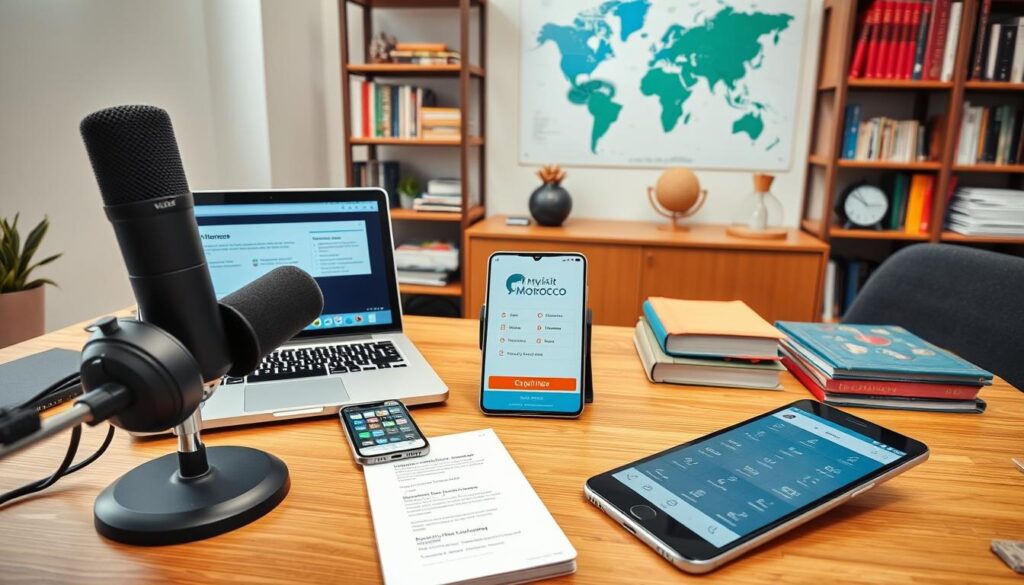
Using these digital tools can really help you improve your translation skills. They are useful for personal, educational, or professional needs.
Working with Professional Moroccan Translators
Dealing with Moroccan Arabic, or Darija, can be tricky. Professional translation services are very helpful. They ensure your messages are clear and respectful of the culture.
When to Hire a Professional Translator
For important documents like business contracts or legal papers, get a pro. They make sure the meaning of Moroccan Arabic is right in English. This prevents misunderstandings.
Finding Qualified Moroccan Language Specialists
Look for translators who know Moroccan Arabic well. Check online, ask for recommendations, or use professional directories. Make sure they have good feedback and experience.
Rates and Expectations for Translation Services
Translation costs depend on the text’s complexity, the translator’s skill, and how fast you need it. Expect a clear price and timely work. Knowing what you need and the translator’s skills helps you choose wisely.
Professional Moroccan translators make your messages clear and respectful. They are key for business, legal, or personal needs in our global world.
Cultural Context in Moroccan to English Translation
Translating from Moroccan Arabic to English is more than just knowing the language. It also needs a deep understanding of Moroccan culture. This cultural context is key to making sure the translation is accurate.
Religious and Traditional References
Morocco is a country deeply rooted in Islam. Translations must handle religious and traditional references with care. For example, phrases about Allah or Islamic holidays need to be translated with respect. You can learn more about these references in this document.
Social Customs and Etiquette
Knowing about social customs is crucial for good translation. Moroccan etiquette, like greetings and saying thank you, is different from Western ways. For instance, formal greetings in Moroccan Arabic show respect through specific phrases.
Historical and Political Sensitivities
Translations can be influenced by history and politics. References to Morocco’s past, political leaders, or sensitive topics need careful handling. Translators must be mindful of these to offer accurate and respectful translations.
| Cultural Aspect | Translation Consideration |
|---|---|
| Religious References | Sensitivity to Islamic phrases and holidays |
| Social Customs | Understanding of formal and informal etiquette |
| Historical and Political Sensitivities | Awareness of historical and political contexts |
By taking these cultural factors into account, translators can offer more precise and culturally aware Moroccan language services. Whether you need an English to Moroccan translator or translation for business, grasping cultural context is essential.
Conclusion
Exploring Moroccan Arabic, or Darija, and its English translation has deepened your understanding. You now see the language’s unique traits and cultural background. A good moroccan dictionary is key to effective communication across cultures.
Online moroccan translation tools can boost your language skills. They help you tackle complex translation tasks with ease. Whether you travel, work, or love languages, speaking Moroccan Arabic opens new doors.
As you delve into Morocco’s rich culture, remember language’s importance. Knowing how to translate from Moroccan to English, along with cultural insight, prepares you. You’ll be ready to explore this captivating region’s complexities.



 Covers cities, coast, mountains, desert & food